
Maple (likely hard/sugar maple)
By Tomas Alder
See how to identify maple wood from one pale board face, read its curved grain, and choose an end-grain photo to check the scan’s tentative result.
Identification summary
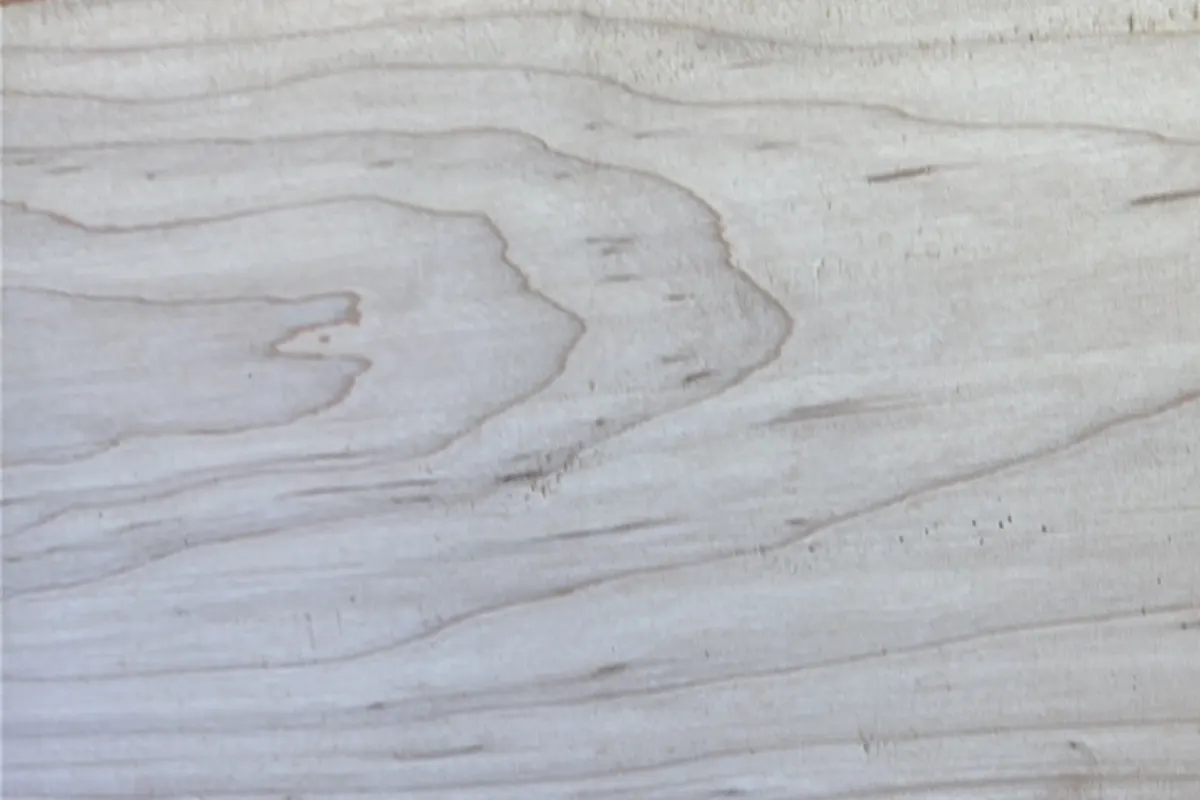
The scanner returned “Maple (likely hard/sugar maple).” On the broad face of the board, narrow brown lines curve around a pale center, with a few short darker streaks inside the arcs. Those marks give us a place to start comparing samples.
The picture shows the face of the board. It leaves the cut end out of view, so the pore pattern needed for a closer identification is still missing. The narrower sugar maple label remains tentative.
Material
| Scan result | Maple (likely hard/sugar maple) |
|---|
Physical Details
| Visible in this photograph | Pale face, nested curved grain lines and a few short darker streaks |
|---|
Origin
| Common range reported by the app | Northeastern North America (commonly) |
|---|
Authentication
| Most useful additional view | A sharp close-up of an exposed cut end, with a scale |
|---|
Historical context
Hard maple and soft maple are both sold as lumber. Their similar appearance is one reason to keep the scan’s broad maple identification separate from its narrower species suggestion.
What you can see on this board
If you want to know how to identify maple wood from a photo, start by tracing one of the darker lines through the pale field. On this board the lines follow one another in broad arcs. That pattern shows how the saw crossed the growth rings. You can see a similar pattern on boards cut from other trees.
The face looks fairly even in texture, including inside the smallest arc. There are no conspicuous rows of open pores at this scale. A smooth surface, a finish, or the resolution of a photograph can all hide pores. Record that detail as an observation before comparing it with a known sample.
Check the cut end and the source of the board
For a second photograph, turn the board so the camera faces across the ends of the fibers. Use an already exposed, clean end. Put a ruler beside it, use the close-focus setting, and check that the wood itself is sharp. If this is finished furniture, look first for an accessible edge on the underside or inside a drawer. An end-grain view of a loose matching offcut is useful if you know it came from the same board.
On end grain, examine how the pores are distributed across a growth ring. In maple, the small pores are spread through the ring. A prominent band of much larger earlywood pores would point toward a different group of hardwoods, such as oak. Other fine-textured woods can resemble maple, so a similar pore pattern still leaves choices open.
The app lists “Northeastern North America (commonly)” in its origin field. That describes a common range for the proposed wood. To establish where this board came from, look for a supplier label or a record tied to the piece. The curved grain lines tell you nothing about its geographic origin.
Why the hard maple label needs a second look
The USDA Forest Products Laboratory groups sugar and black maple under the lumber name hard maple. It describes hard maple as fine and even in texture and notes that soft maple resembles it. The weight of a finished drawer or tabletop is a poor way to decide between them because the hardware, dimensions and other materials contribute to the weight. See the USDA maple technical sheet (https://www.fpl.fs.usda.gov/documnts/TechSheets/HardwoodNA/pdf_files/acerspeng.pdf).
If you are identifying an assembled piece, follow the grain to a joint or exposed edge. An edge strip can be a different wood from the face. A visible backing layer beneath a thin face points to veneer. Photograph that junction before assuming the label applies to the whole piece. The furniture wood guide shows which views to compare across types of hardwood (https://woodidentification.app/blog/furniture-wood-types).
Related guides
Compare your board with Wood Identifier
Take a photo of the broad face and a second close-up of an exposed end. Start with the clearest view in the free wood identifier, then compare the suggested wood with the features you can see on your sample. https://woodidentification.app/tools/wood-identifier
Take the next step →Frequently asked questions
Do the curved grain lines identify this as sugar maple?
The curves trace growth rings exposed on the face. That shape depends partly on the cut. It is compatible with maple and also occurs in other woods.
Where should I photograph this board next?
Use an exposed end where the fibers point toward the camera. Include a scale, take a close-up in even light, and keep the original face photo so you can compare the two views.
Could this board face be birch or a maple veneer?
Birch is another pale, fine-textured wood worth comparing. Veneer is a separate question about construction. An exposed edge can reveal a thin surface layer over a different core, even if the face itself is maple.
Does the scan tell me where the tree grew?
The app gives a common region for maple. Establishing where this particular tree grew would require a source record tied to the lumber.